…An Unforgettable Day with Mathematical Segun Odegbami
Some journeys are measured in kilometres. Others are measured by the memories they leave behind, the lessons they teach us, and the quiet transformation they bring to our understanding of life. My journey to Wasimi, Ogun State, today was one of those rare experiences that will remain with me for a very long time.
It was more than a photographic assignment. It was a journey into the extraordinary vision of an ordinary man who decided that his greatest legacy would not be the wealth he accumulated, but the lives he transformed.
About eight years ago, Chief Olusegun Patrick Odegbami, the legendary Mathematical Segun Odegbami, invited me to Wasimi to establish a photography darkroom at his school, SOCA. For one reason or another, I never made the journey. There was always another assignment, another engagement, another pressing commitment. Before I knew it, eight years had passed.
Then, early in 2026, another idea emerged. Uncle Sege discussed it with his egbon, longtime friend and, as I fondly describe him, his partner in crime, the legendary filmmaker Uncle Tunde Kelani, affectionately known as Uncle TK. Their friendship dates back to 1972, more than half a century of shared experiences, mutual respect and enduring brotherhood.
Uncle Sege subsequently called me, and this time something told me that I had postponed this visit long enough.
I finally said to myself, it is time to visit Wasimi and discover one of the beautiful wonders of Nigeria that many of us know so little about.
Little did I realise how profoundly the day would affect me.
My journey began very early this morning from Lagos.
As I drove along the Lagos–Ibadan Expressway and eventually turned towards Abeokuta, I found myself reflecting on something that has increasingly occupied my thoughts: the enormous difference between the Nigeria we hear about every day and the Nigeria we sometimes discover when we venture beyond our comfort zones.
We live in a country where negative stories dominate much of our media space. The daily commentary about the economy, unemployment, inflation and hardship can sometimes leave one with the impression that nothing positive is happening anywhere.
Let me be clear. I am not suggesting that Nigerians are not experiencing genuine economic difficulties. Many families are struggling, and those challenges must never be dismissed.
But there is also another Nigeria whose story deserves to be told.
What I witnessed on the journey was remarkable.
From Lagos towards the Sagamu Interchange, stretches of land that I remembered as thick, bushy vegetation have gradually given way to factories, warehouses, industrial complexes and new construction sites.
Indeed, there were portions of the expressway where one could hardly identify an undeveloped plot of land. And as I continued towards Abeokuta, the pattern became even more fascinating.
On both sides of the road were new factories, completed industrial facilities and others under construction. Nigerians were working at these sites. Heavy-duty trucks moved in both directions, carrying containers, goods, machinery and materials.
I looked at the endless movement of commercial vehicles and the expanding industrial landscape, and my mind began to wander.
Who owns all these businesses? How many people do they employ? How much economic activity takes place here every day? Where does the money circulate? And, perhaps most importantly, how can I position myself to contribute meaningfully to this developing economy?
My thinking cap was firmly on.
I have spent more than two decades documenting Nigeria, travelling across all 774 Local Government Areas, and I know that this country has an extraordinary capacity to surprise those willing to look beyond the headlines.
What I saw this morning reminded me that while we must acknowledge our problems, we must also recognise our possibilities.
I would rather spend my energy looking for opportunities to contribute to Nigeria’s economic revival than become another voice convinced that nothing good can ever happen here.
There is so much more to this country than the stories of despair that dominate our conversations.
And that was only the beginning of my day.
I arrived in Abeokuta before 8 a.m.
When I called Uncle Sege to announce my arrival, he could hardly believe it. I had caught him completely unprepared, and my early arrival sent him rushing to get ready.
But that is the beauty of genuine friendship. There was no ceremony, no unnecessary protocol, just the warmth of a man genuinely delighted to receive his guest.
Unknown to me, Uncle Sege had already made elaborate arrangements for my visit.
Fresh palm wine had been brought from the farm that morning. There was homemade bread, freshly boiled eggs and vegetables straight from his garden. The onions, tomatoes and cabbage were freshly harvested, the kind of farm-to-table experience that money cannot always buy in our increasingly hurried urban lives.
There was something deeply satisfying about that breakfast.
No unnecessary extravagance. No artificial sophistication. Just fresh food, a peaceful environment, genuine hospitality and the unmistakable contentment of a man enjoying the simple blessings of life.
I looked around and thought to myself, what a beautiful way to live!
There, in Abeokuta, away from the endless noise, traffic and pressures of Lagos, was a man who seemed to understand something many of us spend our entire lives trying to discover.
That life is not always about having more.
Sometimes, it is about appreciating what you already have.
You cannot spend time with Uncle Sege without learning something.
After breakfast, we began our journey to Wasimi, his ancestral village, the resting place of his parents and the place where he hopes, when his own earthly journey eventually ends, to be laid to rest.
As we approached Wasimi, something beautiful happened.
Uncle Sege’s face suddenly lit up.
He asked us to stop the vehicle, get out and look at the village from a distance.
There was an unmistakable pride in his voice as he surveyed the landscape.
This was not merely a village to him. It was home. It was history. It was the land of his ancestors. It was where the memories of his parents lived, and where a dream conceived many years ago had gradually become a living reality.
Standing there, he began telling me the extraordinary story of how SOCA came into existence.
He took me back to the period when he contested for the chairmanship of the Nigeria Football Federation.
He had committed a considerable amount of his personal resources to the ambition, believing that he could make a meaningful difference to Nigerian football.
But as the campaign progressed, the financial demands became overwhelming.
At some point, even before the election had taken place, he realised that he had spent almost everything he had available, leaving himself with less than ₦5 million.
It was a sobering moment.
He had to ask himself a difficult question.
Should he continue pouring his resources into a political ambition whose outcome was uncertain, or redirect what remained into something that could create a lasting difference in the lives of young Nigerians?
That moment of reflection became a turning point.
Sometimes, what appears to be a disappointment in life is actually God’s way of redirecting us towards our true purpose.
Uncle Sege chose purpose.
With approximately 40 hectares of land in Wasimi, he returned to his ancestral home to pursue a dream he had carried within him for years: establishing an educational and sports academy where young Nigerians could receive sound education while developing their sporting talents.
The beauty of the land had first captivated him during his father’s funeral. Looking across the village from the church in Wasimi, he saw something beyond the physical landscape.
He saw possibilities.
He saw young children discovering their talents.
He saw a school where education and sports could exist side by side.
He saw a future.
And he decided to build it.
One of the most touching parts of his narration was the influence of his dear friend, Uncle Tunde Kelani.
As Uncle Sege reflected on the philosophy behind SOCA, he recalled something Uncle TK had told him when they were much younger.
Rather than devote their lives to building grand mansions for themselves, they should strive to make a meaningful impact on the younger generation.
What a profound philosophy!
It is particularly striking in a society where success is often measured by the number of houses we own, the cars we drive, the size of our bank accounts and the titles attached to our names.
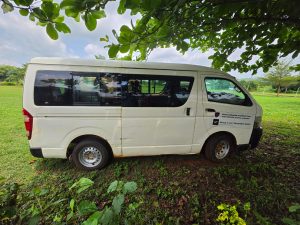
Here was a man who had enjoyed national fame, represented Nigeria with distinction, become one of the most recognisable faces in African football and could easily have chosen a life centred entirely on his personal comfort.
Instead, he chose to invest in children.
And the result speaks for itself.
SOCA began approximately twenty years ago with just 20 children.
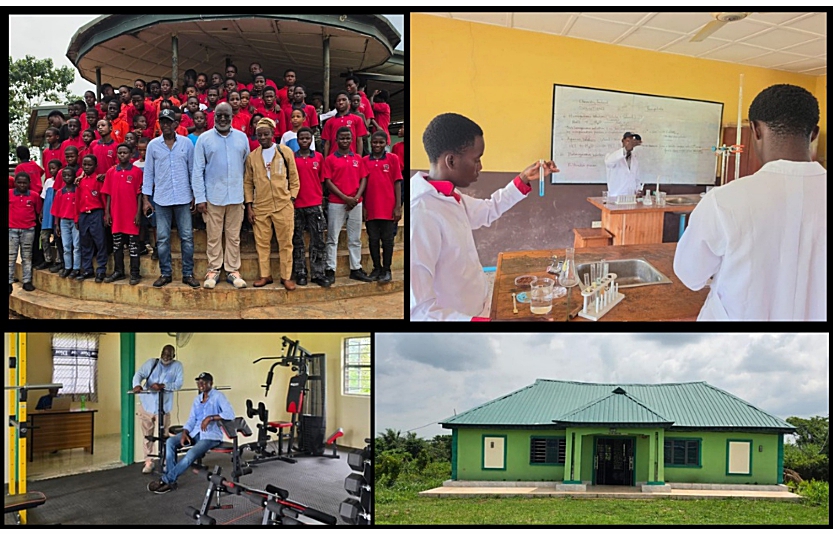
Today, the academy has about 120 students, from Junior Secondary School One to Senior Secondary School Three.
According to Uncle Sege, more than 100 students have, over the years, secured full scholarships to study in the United States of America.
Just imagine that for a moment.
More than 100 young lives given opportunities that might otherwise have remained beyond their reach.
Behind every scholarship is a family whose story has changed. Behind every graduate is a dream that has been given the chance to grow.
And behind it all is one man’s determination to make his existence count for something greater than himself.
Whenever Uncle Sege spoke about the children, his expression changed.
His eyes brightened, his voice grew more animated, and the pride in his achievements became impossible to conceal.
This was not the pride of a man showing off his possessions.
It was the quiet fulfilment of a man watching his vision become somebody else’s opportunity.
The final approach to the academy was an adventure in itself.
We descended from the old Abeokuta–Lagos Road into Wasimi and began climbing again along a reddish, muddy road made slippery by the heavy rainfall of the previous night.
And then, almost unexpectedly, the black entrance gate of the school appeared before us.
There was nothing ostentatious about the entrance.
No elaborate announcement of the remarkable institution hidden beyond it.
But when the gateman opened the gate and we drove inside, I immediately understood why Uncle Sege had been so eager for me to visit.
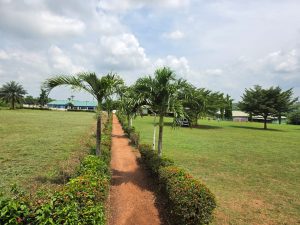
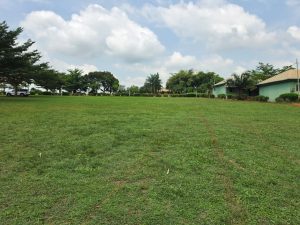
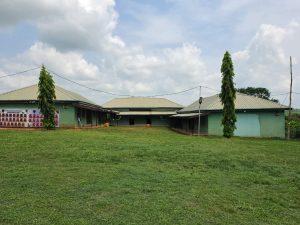
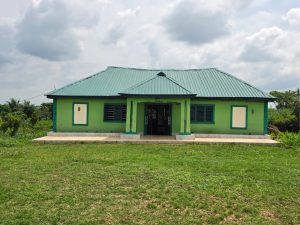
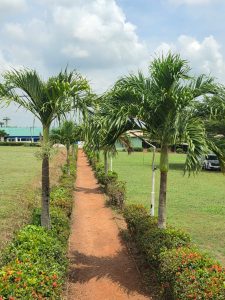
The first thing that struck me was the greenery.
Beautiful, lush vegetation stretched across the environment. The fresh landscape, nourished by the previous night’s rain, contrasted beautifully with the blue sky and patches of white clouds overhead.
To a photographer, it was an irresistible sight.
It was almost as though nature had deliberately arranged the colours for my camera.
Green beneath my feet, blue above my head, and white clouds drifting gently across the sky.
I had finally arrived at a place I had imagined for almost a decade.
And the reality was even more touching than the picture I had carried in my mind.
As we settled in, some of the students came out to welcome us, led by their Senior Girl, Florence.
Their greetings were warm, polite and respectful.
Throughout my visit, the students greeted us whenever we crossed paths.
There was a sense of discipline and orderliness that spoke volumes about the values being instilled in them.
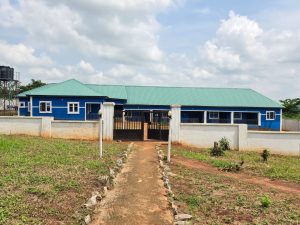
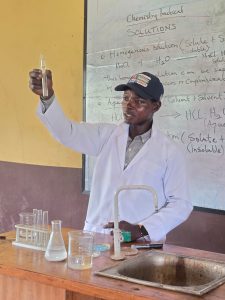
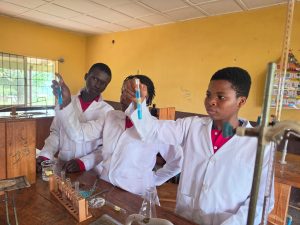
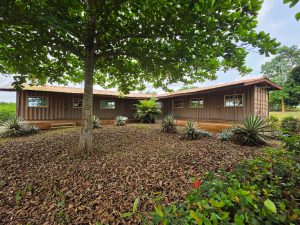
I visited the classrooms, met the teachers and non-academic staff, and walked around the facilities.
The sports field was impressive, a physical expression of Uncle Sege’s determination to develop both the intellect and sporting abilities of his students.
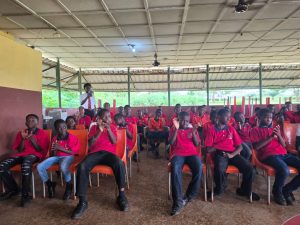
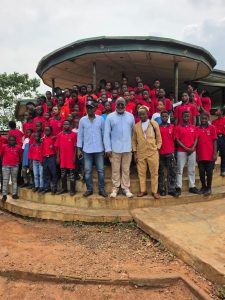
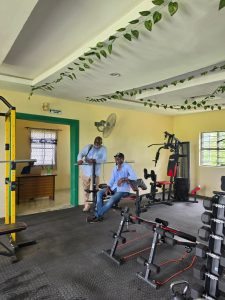
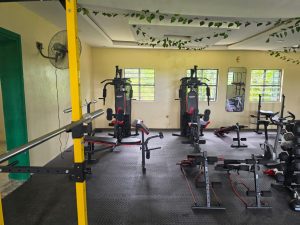
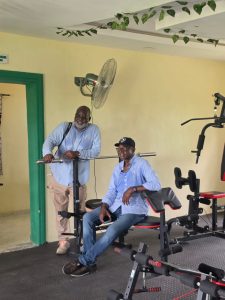
The gymnasium was modern and well-equipped. I even joked that if the academy were located in the heart of a major town, the gym could easily operate as a commercial fitness centre, charging members of the public for its facilities.
We laughed.
But behind the laughter was my growing admiration for the thought, planning and sacrifice that had gone into the institution.
I also saw the school clinic, with three students just emerging from it, another reminder of the care required to operate a fully residential school.
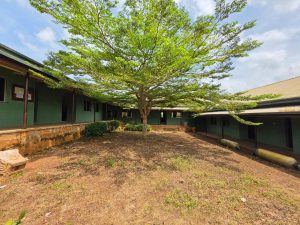
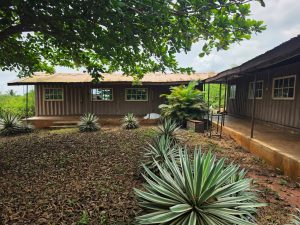
The environment was clean, peaceful and beautifully green.
There were also approximately two acres devoted to yam and cassava cultivation, adding another dimension to the children’s learning environment.
This was not simply a place where students attended classes, passed examinations and moved on.
It was a place where young people could learn about life, responsibility, community, nature, discipline and the dignity of purposeful work.
And I found myself thinking about what these children would say many years from now.
Some will become professionals. Some may become celebrated athletes. Others may become entrepreneurs, teachers, scientists or leaders.
But whatever paths they eventually follow, they will carry a part of Wasimi with them.
And somewhere in their stories will be the name of a man who believed in them before the world knew who they were.
I was privileged to address the students briefly.
I spoke to them about life, photography, discovering their passions and the importance of remaining committed to whatever gives their lives meaning.
I reminded them that the journey to success is rarely straightforward, and that passion, discipline, perseverance and a sense of purpose can take them to places they may never have imagined.
Standing before those young faces, I thought about my own life.
The little boy who developed a love for photography.
The long journeys across Nigeria.
The countless uncertainties, sacrifices, disappointments and unexpected blessings.
And how one passion, pursued with determination, had opened doors I could never have imagined when I began.
I wanted the students to understand that there is dignity in discovering what you love and pursuing it with everything within you.
I also wanted them to appreciate the extraordinary opportunity they had been given.
Because not every child has an Uncle Sege.
Not every child has someone willing to sacrifice personal comfort to create a better future for them.
As the visit gradually came to an end, I found myself becoming unexpectedly emotional.
Something about the environment awakened a memory buried deep within me.
I remembered my own mother leaving me years ago in the bush at Oke Ife, Ijebu Ife.
The memory came rushing back with an intensity I had not anticipated.
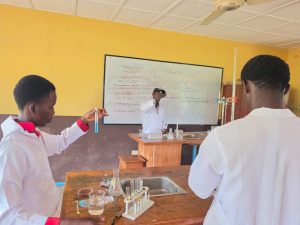
Perhaps it was the rural setting. Perhaps it was the sight of young children living away from their families. Perhaps it was simply the passage of time and the realisation of how far life had brought me.
SOCA is a fully boarding institution, and I could not help imagining the emotions of parents who bring their children there, entrusting their hopes, fears and dreams to the school.
Every child has a story.
Every parent has a prayer.
And every institution like this carries a responsibility far greater than its physical structures.
I looked at the students one more time and quietly wished them well.
I prayed that the dreams which brought them to Wasimi would not die there, but would find their wings and carry them across the world.
Leaving the academy was much harder emotionally than I had expected.
I had come to take photographs.
I was leaving with something far more valuable than photographs: a renewed appreciation of what it truly means to make a difference.
Our journey did not end at the academy.
From Wasimi, we proceeded to Eagle 7 FM, where I had the pleasure of being featured on radio alongside Uncle Tunde Kelani.
Spending time with these two extraordinary men was a privilege in itself.
Here were two Nigerian legends, one celebrated for his genius on the football field and the other for his extraordinary contribution to filmmaking and the preservation of our cultural heritage.
Different professions, different expressions of creativity, but united by friendship, conviction and the desire to contribute something meaningful to society.
There is something deeply reassuring about friendships that survive the passage of more than fifty years.
In a world where relationships are sometimes measured by convenience and personal advantage, their enduring brotherhood is itself a beautiful story.
And as though the day had not already given me enough memorable experiences, I also enjoyed my first proper encounter with Ofada rice served with its traditional, richly flavoured stew.
What a delightful culinary experience!
Fresh palm wine in the morning, homemade bread and vegetables from the garden, a journey through history and purpose, an inspiring school, an unforgettable encounter with young Nigerians, a radio appearance with Uncle TK, and finally, a delicious plate of Ofada rice.
What more could one ask of a single day?
As I reflected on the day, one thought kept returning to my mind.
What exactly do we consider achievement in life?
Is it the number of properties we acquire?
Is it the wealth we accumulate?
Is it the titles we bear, the influential people we know, or the luxury we surround ourselves with?
There is nothing wrong with material success. We all work hard to provide for ourselves and our families, and there is dignity in enjoying the fruits of honest labour.
But surely, there must be something more.
At some point in our lives, we must ask ourselves what will remain when we are no longer here to enjoy those possessions.
Who will remember us?
And, more importantly, why will they remember us?
Uncle Sege could have built himself another mansion on those 40 hectares of land.
He could have created a private estate, fenced it off from the world and enjoyed his retirement in complete comfort.
Instead, he built a place where children can dream.
A place where a young boy or girl from an ordinary Nigerian family can discover a talent, receive an education and perhaps earn a scholarship that changes the course of an entire family’s history.
A place where the name Segun Odegbami will mean far more than the goals he scored or the football matches he played.
That, to me, is greatness.
And perhaps that is why his face lights up whenever he speaks about SOCA.
He is not merely looking at school buildings, sports facilities or classrooms.
He is looking at his legacy.
My visit also reminded me of a simple truth that I have come to appreciate increasingly with age: the greatest achievements in life are not always the things we build for ourselves, but the opportunities we create for others.
As I continue my own journey of documenting and preserving Nigeria’s history, culture and heritage, I find renewed inspiration in individuals who choose to translate their dreams into institutions that will outlive them.
There are many such remarkable Nigerians quietly making a difference across this country.
Unfortunately, their stories do not always command the headlines.
Perhaps we need to spend more time finding them, listening to them, celebrating them and documenting their contributions.
Nigeria is filled with extraordinary stories waiting to be discovered.
Sometimes, all we need to do is leave the comfort of our homes and go looking.
Dear Uncle Sege, thank you for your friendship, your hospitality, your generosity of spirit and, above all, for allowing me to witness the beautiful dream you have nurtured for approximately two decades.
Thank you for reminding me that a life of significance is not necessarily a life of material abundance, but one that brings hope and opportunity to others.
Thank you, too, Uncle Tunde Kelani, for being part of this remarkable story and for demonstrating, through your enduring friendship, the beauty of shared values and lifelong loyalty.
I came to Wasimi as a photographer hoping to capture beautiful images.
I left as a student of life, humbled by the vision, sacrifices and quiet determination of a man who chose to build lives rather than mansions.
Today, I saw another side of Nigeria.
I saw industry and enterprise along our highways.
I saw the beauty of rural life.
I saw the strength of friendship.
I saw the power of one man’s vision.
And, most importantly, I saw hope in the faces of young Nigerians whose futures are being shaped by the kindness and sacrifice of others.
It was a day of discovery, reflection, nostalgia, gratitude and inspiration.
Some journeys take us to places. Others take us deeper into the meaning of life.
My journey to Wasimi did both.
And when the story of my life is eventually told, I know that this day spent with the legendary Mathematical Segun Odegbami will find a special place among my most treasured memories.
Because, long after the photographs have been taken, the conversations have ended and the journey has become another entry in my travel diary, one lesson will remain:
We may not all have the power to change the whole world, but each of us has the capacity to change somebody’s world.
Uncle Sege has chosen to change the world of many young Nigerians.
And for that, he deserves our admiration, appreciation and celebration.
What a day. What a journey. What a man. What a legacy.
Wasimi, Ogun State — Thursday, 22 October 2026.
‘𝘿𝘼𝙔𝙊 𝘼𝘿𝙀𝘿𝘼𝙔𝙊 𝙞𝙨 𝙖 𝙉𝙞𝙜𝙚𝙧𝙞𝙖𝙣 𝘿𝙤𝙘𝙪𝙢𝙚𝙣𝙩𝙖𝙧𝙮 𝙋𝙝𝙤𝙩𝙤𝙜𝙧𝙖𝙥𝙝𝙚𝙧, 𝘼𝙧𝙩𝙞𝙨𝙩, 𝘾𝙪𝙡𝙩𝙪𝙧𝙖𝙡 𝘼𝙣𝙩𝙝𝙧𝙤𝙥𝙤𝙡𝙤𝙜𝙞𝙨𝙩, 𝙑𝙞𝙨𝙪𝙖𝙡 𝙎𝙩𝙤𝙧𝙮𝙩𝙚𝙡𝙡𝙚𝙧 𝙖𝙣𝙙 𝘼𝙪𝙩𝙝𝙤𝙧