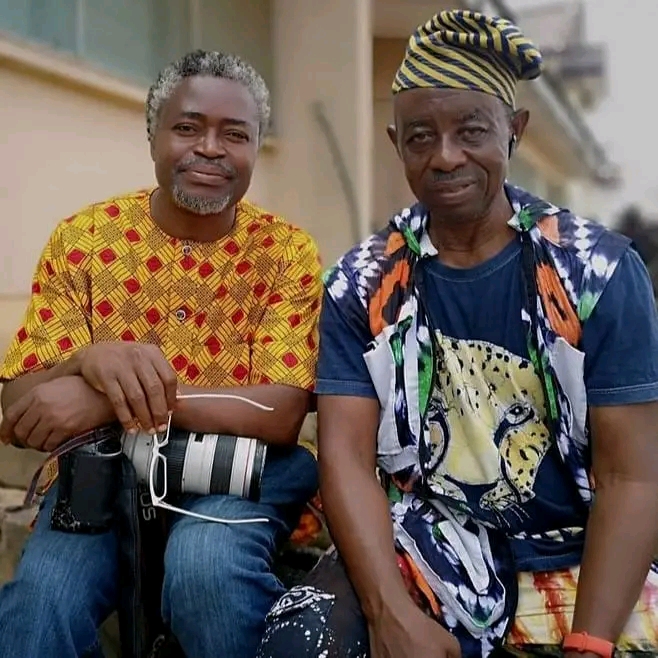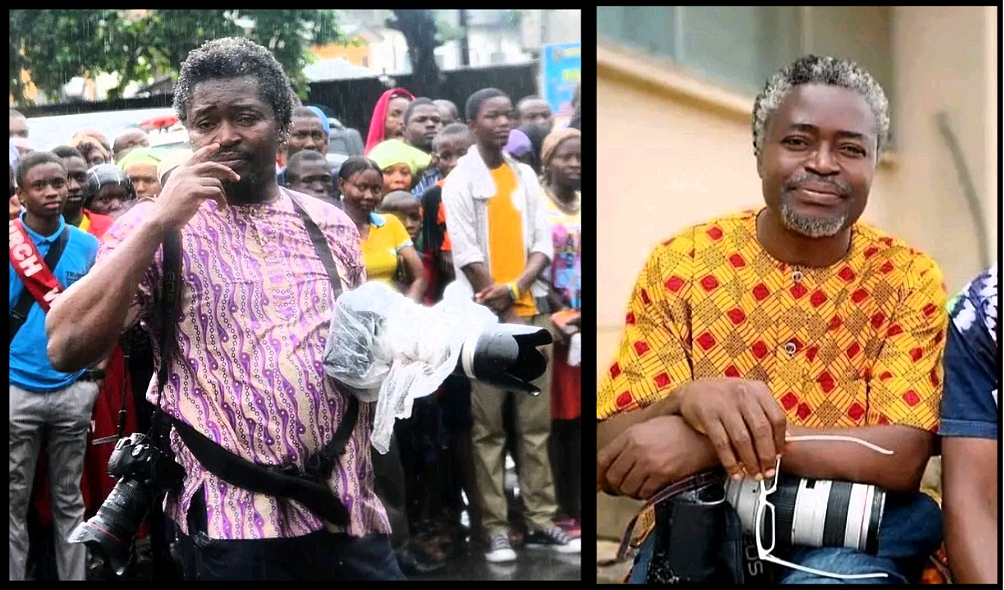
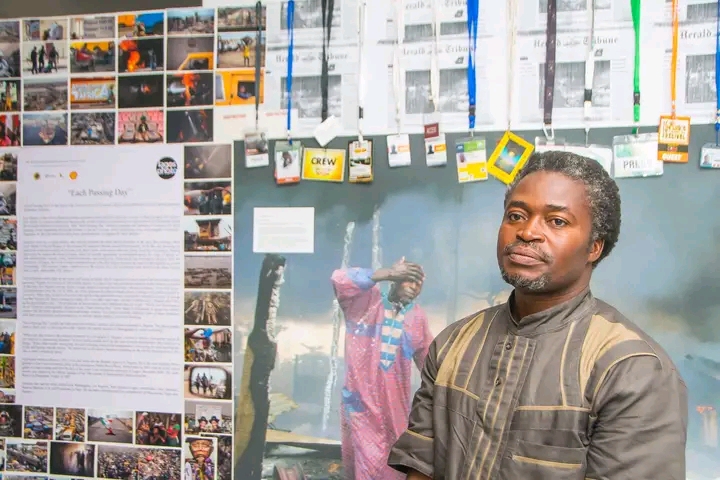
Akintunde Akinleye (born 19 April 1971) is a Nigerian photojournalist whose work revolves around photo-activism and narratives of trial and adversity. A former Reuters photographer covering West Africa, his photography has chronicled Nigeria’s postcolonial history. He is the first Nigerian photographer to win the World Press Photo prize (2007) for his photograph of a pipeline explosion in Lagos. In the same year, he was honored with the National Geographic All Roads award. His photographs have been featured in publications like Time, Vogue, The New York Times, among others.
Early Life
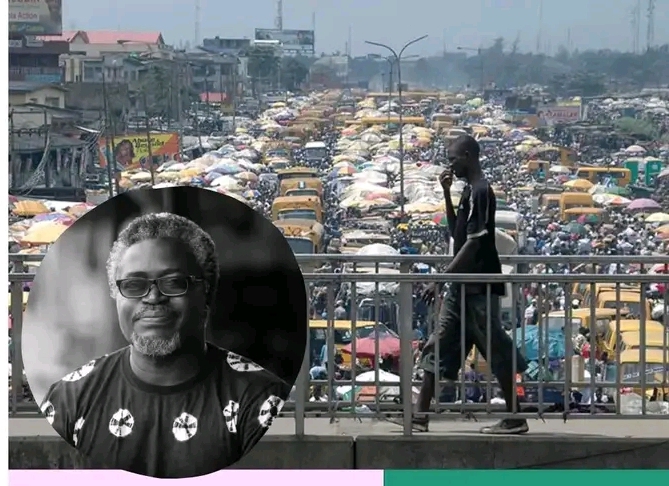
Though his parents, Joel Oloruntoba and Ebuoluwa Racheal, hailed from Okemesi-Ekiti in southwest Nigeria, Akintunde was born and raised in Mushin, Lagos. His mother, concerned about his playful nature and frequent street football games, decided to keep him occupied. At age 11, she gifted him a camera, noticing his interest in drawing images in the sand. He was also enrolled in an after-school apprenticeship program at a local photo studio to learn portrait photography.
Education
At the age of five, Akintunde began his primary education at St. Jude’s Primary School in Mushin and later transferred to Layi-Oyekanmi Primary School when the government expanded the public school system in 1979. He then attended Eko Boys’ High School (EBHS) for his secondary education from 1983 to 1988.
In 1997, Akintunde earned a bachelor’s degree in Social Studies Education from Ondo State University in Ado Ekiti (now Ekiti State University). He later attended the Nigerian Institute of Journalism (NIJ) in Lagos, where he obtained a postgraduate diploma in
Journalism.
Following this, he pursued two master’s degrees: one in Mass Communication at the University of Lagos and another in Film Studies at Carleton University, Ottawa. He then began a Ph.D. program in anthropology at Carleton University, focusing on the dynamic complexities of framing, visual material culture, and representation.
After completing a workshop on documentary photography and photojournalism, organized by the World Press Photo Foundation at the Nigerian Institute of Journalism in Lagos in 2005, Akintunde was appointed as a guest lecturer for a proficiency certificate course in photojournalism, aiming to elevate the standard of the profession in Nigeria. As a Ph.D. candidate, he has taught courses in African popular culture, African cinema, and visual anthropology at Carleton University. During fieldwork for his doctoral research—Gendering a Small God: Gelede Religion, Pentecostal Media, and Spirituality in Urban Lagos—Akintunde took up an adjunct teaching position at the School of Media and Film at Pan-Atlantic University, Lagos, where he taught topics in photo/video journalism.
Career in Photojournalism
Akintunde started his photojournalism career at Daily Independent, a local newspaper in Lagos, a few years after obtaining his bachelor’s degree. While covering the coronation of the Oba of Lagos, Oba Riliwan Akiolu, he was reportedly assaulted by security officers for getting too close to Vice President Atiku Abubakar. His camera was destroyed, and he spent a month in the hospital.
In 2006, he began working for Reuters as a correspondent for the West Africa region, under the leadership of Finbarr O’Reilly, the Reuters regional editor at the time. He temporarily stepped away from journalism in 2018, resigning from his position at Reuters to focus on his doctoral studies.
A 2015 article in The New York Times noted that his work brings “kinetic landscapes to life.” Akintunde has been nominated four times for the Prix Pictet award in Photography and Sustainability for his projects Delta: A Vanishing Wetland, Delta Bush Refineries, Makoko: Life on Stilt, and Lagos’ Firemen.
The World Press Photo Prize
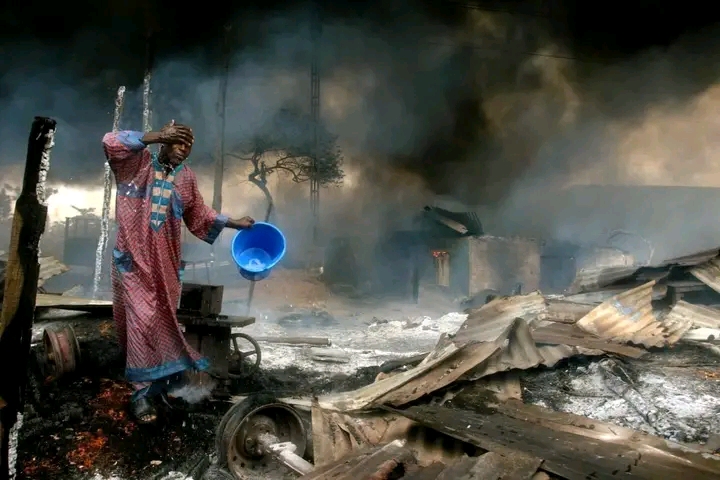
In 2007, Akintunde won the World Press Photo prize for spot news with a photograph of a man rinsing soot from his face after a pipeline explosion in Abule Egba, a Lagos suburb. He arrived at the scene of the explosion just ten minutes after it started, having navigated Lagos traffic on a bike. Surrounded by billowing smoke, he saw a man using the last of his water to wash his face and captured five or six images before moving to another scene. The prize-winning photograph was reportedly the last of this sequence.
Akintunde debated whether to send the photograph to his editor, questioning if it was too artistic and dramatic to qualify as good photojournalism. He spent half an hour deliberating before sending it.
The image was later named by The Guardian as one of the best photos of the decade.
Personal Life
Akintunde is married to Omobolanle Dada-Akinleye (“Omo-B”). They have four children: Akinbusayo, Akinola, Ibukunoluwa, and Eniola.